14:26
Australia prepares legal action against social media giants over under-16 ban

13:54
You can reserve Tesla’s new Roadster in the UAE for Dh210,000

12:49
Is AI getting out of control? Kaspersky on the risks that matter

18:26
Telegram launches Money, its built-in crypto wallet: Here's how it works

15:05
Telegram Desktop vulnerability allowed attackers to steal files with one click

12:33
Anthropic will ban repeated abuse of Claude under new usage rules
14:26
Australia prepares legal action against social media giants over under-16 ban
13:54
You can reserve Tesla’s new Roadster in the UAE for Dh210,000
12:49
Is AI getting out of control? Kaspersky on the risks that matter
18:26
Telegram launches Money, its built-in crypto wallet: Here's how it works
15:05
Telegram Desktop vulnerability allowed attackers to steal files with one click
12:33
Anthropic will ban repeated abuse of Claude under new usage rules
14:26
Australia prepares legal action against social media giants over under-16 ban
13:54
You can reserve Tesla’s new Roadster in the UAE for Dh210,000
12:49
Is AI getting out of control? Kaspersky on the risks that matter
18:26
Telegram launches Money, its built-in crypto wallet: Here's how it works
15:05
Telegram Desktop vulnerability allowed attackers to steal files with one click
12:33
Anthropic will ban repeated abuse of Claude under new usage rules
14:26
Australia prepares legal action against social media giants over under-16 ban
13:54
You can reserve Tesla’s new Roadster in the UAE for Dh210,000
12:49
Is AI getting out of control? Kaspersky on the risks that matter
18:26
Telegram launches Money, its built-in crypto wallet: Here's how it works
15:05
Telegram Desktop vulnerability allowed attackers to steal files with one click
12:33
Anthropic will ban repeated abuse of Claude under new usage rules


YouTube is no longer relying solely on creators to disclose AI use in their videos. The platform will now automatically apply labels when its internal systems detect significant photorealistic AI content, according to an official update from the company.
AI labels have been part of YouTube's policy for over two years. Until now, the responsibility for disclosure rested on creators, who were required to declare AI content that could be mistaken for a real person, place, or event. Videos featuring clearly animated or fantastical content were exempt from the requirement. The new system means YouTube will step in directly when creators either fail or forget to disclose AI use, applying the label on their behalf.
Starting in May, the platform will use new internal signals to detect AI-generated content and add labels accordingly. The company says its underlying AI labeling policy has not changed, but YouTube will now take a more active role in enforcing it. The shift comes shortly after Google introduced Gemini Omni at its I/O developer conference, a new family of multimodal AI models capable of generating high-quality videos that reflect an understanding of physics, culture, history, and science.
 Daria Ivanova
Alongside automatic detection, YouTube is also making its labels more visible. For long-form videos, the disclosure will now appear directly below the video player and above the description. For Shorts, the label will be displayed as an overlay on the video itself. Less prominent labels will remain in the expanded description for content that is animated, unrealistic, or only slightly altered. The redesign is intended to give viewers immediate context for photorealistic AI content, rather than burying the disclosure several clicks deep.
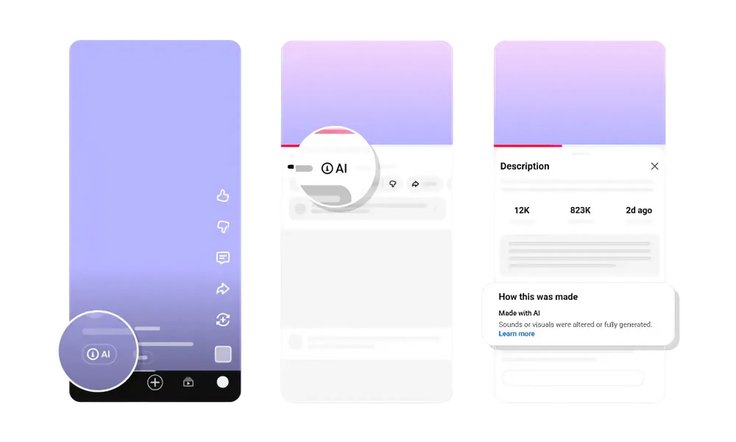
Creators who believe their content was incorrectly identified as AI-generated will be able to update the disclosure status in YouTube Studio. There are two exceptions where labels remain permanent: videos made using YouTube's own AI tools such as Veo or Dream Screen, and videos containing C2PA metadata that confirms the content is fully AI-generated.
YouTube has stated that AI labels will not affect how a video is recommended or its ability to be monetized. The system is positioned as a transparency measure for viewers rather than a penalty for creators using AI in their work.







Editor’s pick