18:26
Telegram launches Money, its built-in crypto wallet: Here's how it works

15:05
Telegram Desktop vulnerability allowed attackers to steal files with one click

12:33
Anthropic will ban repeated abuse of Claude under new usage rules

12:02
Apple could unveil its first touchscreen MacBook Pro on October 27

11:46
Meta bans TikTok ads on Facebook and Instagram in seven countries

11:25
Apple reportedly cuts iPhone 18 Pro orders just weeks after launch
18:26
Telegram launches Money, its built-in crypto wallet: Here's how it works
15:05
Telegram Desktop vulnerability allowed attackers to steal files with one click
12:33
Anthropic will ban repeated abuse of Claude under new usage rules
12:02
Apple could unveil its first touchscreen MacBook Pro on October 27
11:46
Meta bans TikTok ads on Facebook and Instagram in seven countries
11:25
Apple reportedly cuts iPhone 18 Pro orders just weeks after launch
18:26
Telegram launches Money, its built-in crypto wallet: Here's how it works
15:05
Telegram Desktop vulnerability allowed attackers to steal files with one click
12:33
Anthropic will ban repeated abuse of Claude under new usage rules
12:02
Apple could unveil its first touchscreen MacBook Pro on October 27
11:46
Meta bans TikTok ads on Facebook and Instagram in seven countries
11:25
Apple reportedly cuts iPhone 18 Pro orders just weeks after launch
18:26
Telegram launches Money, its built-in crypto wallet: Here's how it works
15:05
Telegram Desktop vulnerability allowed attackers to steal files with one click
12:33
Anthropic will ban repeated abuse of Claude under new usage rules
12:02
Apple could unveil its first touchscreen MacBook Pro on October 27
11:46
Meta bans TikTok ads on Facebook and Instagram in seven countries
11:25
Apple reportedly cuts iPhone 18 Pro orders just weeks after launch

Alibaba has unveiled Qwen3.8-2.4T-A95B, the first open-source AI model in its flagship Qwen-Max family.
According to the Qwen team, the model has 2.4 trillion parameters, with only 95 billion activated for each token. It uses a Mixture-of-Experts architecture built around 512 experts, activating only a subset for each request to reduce computational demands while retaining the scale of the full model.
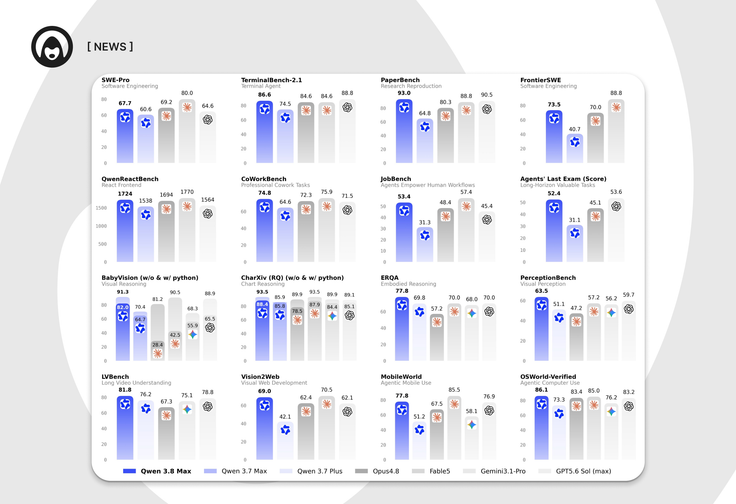
Qwen3.8-Max is designed for long-context and agentic workloads. It natively supports 262,144 tokens of context, which can be extended to around 1 million tokens, making it suitable for lengthy autonomous sessions and working with large collections of documents. Alibaba has focused the model on complex agentic tasks, professional software development, coding and deep research, with improvements to autonomous planning and the ability to respond to feedback from its environment. Users can also control how much reasoning the model applies to a task through a dedicated parameter.
The company compares Qwen3.8-Max with leading models including Anthropic’s Claude Opus 4.8 and Claude Fable 5, OpenAI’s GPT-5.6 Sol and the previous Qwen3.7-Max. According to Alibaba’s own benchmarks, the new model makes significant gains over its predecessor in agentic coding and performs competitively with other flagship models across several general-purpose and professional benchmarks covering areas such as medicine, law and finance. In some tests it comes out ahead, while in others it trails its rivals. These results come from Alibaba’s own testing and provide an indication of the model’s capabilities, although benchmark performance does not necessarily translate directly to real-world workloads.
The weights published on Hugging Face and ModelScope are for the model’s base post-trained version, while the more capable Qwen3.8-Max offered through the API adds image support, a 1-million-token context window and built-in tools. Running an open model of this size also requires substantial server infrastructure, which means many developers may find the cloud API more practical than deploying it themselves.
Still, the release of a model with trillions of parameters under an open license marks another step toward bringing capabilities once largely confined to proprietary cloud models into the open-source ecosystem.







Editor’s pick