19:26
Government websites across Europe go offline over critical PHP flaws

17:37
Agile Robots unveils Nvidia-powered humanoid built to learn new skills

13:30
PHP warns website owners to prepare for emergency security updates

14:26
Australia prepares legal action against social media giants over under-16 ban

13:54
You can reserve Tesla’s new Roadster in the UAE for Dh210,000

18:26
Telegram launches Money, its built-in crypto wallet: Here's how it works
19:26
Government websites across Europe go offline over critical PHP flaws
17:37
Agile Robots unveils Nvidia-powered humanoid built to learn new skills
13:30
PHP warns website owners to prepare for emergency security updates
14:26
Australia prepares legal action against social media giants over under-16 ban
13:54
You can reserve Tesla’s new Roadster in the UAE for Dh210,000
18:26
Telegram launches Money, its built-in crypto wallet: Here's how it works
19:26
Government websites across Europe go offline over critical PHP flaws
17:37
Agile Robots unveils Nvidia-powered humanoid built to learn new skills
13:30
PHP warns website owners to prepare for emergency security updates
14:26
Australia prepares legal action against social media giants over under-16 ban
13:54
You can reserve Tesla’s new Roadster in the UAE for Dh210,000
18:26
Telegram launches Money, its built-in crypto wallet: Here's how it works
19:26
Government websites across Europe go offline over critical PHP flaws
17:37
Agile Robots unveils Nvidia-powered humanoid built to learn new skills
13:30
PHP warns website owners to prepare for emergency security updates
14:26
Australia prepares legal action against social media giants over under-16 ban
13:54
You can reserve Tesla’s new Roadster in the UAE for Dh210,000
18:26
Telegram launches Money, its built-in crypto wallet: Here's how it works


“The Populist”: a new book on Pavel Durov and Telegram as a political phenomenon
Journalist Nikolai V. Kononov has released a new book, "The Populist: The Untold Story of Pavel Durov and Telegram", a continuation of his earlier biography of Telegram’s founder.
The book follows Kononov’s 2012 bestseller The Durov Code and is based on years of observing Pavel Durov and Telegram not merely as a technology company, but as a political and cultural phenomenon.
As the author explains:
"This book is part of a big conversation about how the world went mad and right-wing and falling into tribes. About how one person enjoys a sharp mind and the ability to make difficult decisions instantly - and conspirological thinking. About how much capitalism has distorted many, almost everyone, including myself, into the brains and convinced that there is no alternatives to it. On why powerless, horizontal structures do not rush to replace verticals and hierarchies, and on the contrary, charismatic leadership flourishes.
And of course, about how populism — the ability to address every citizen directly, playing on hopes, fears and passions — is becoming more and more sophisticated at every new stage of technological progress."
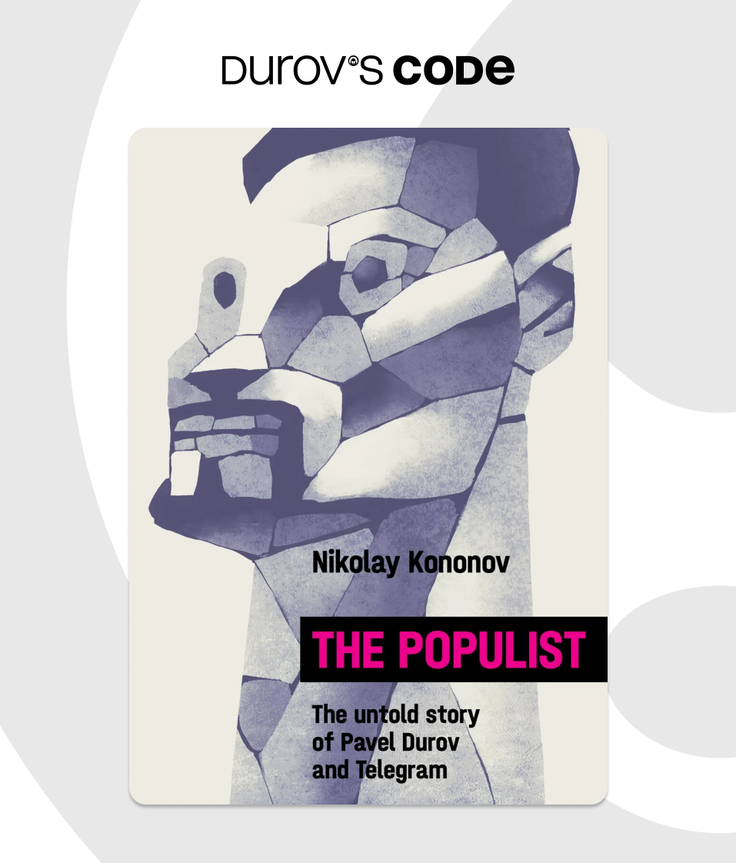
The book is based on a 14-year investigation into Pavel Durov’s strategic thinking and worldview, as well as Telegram’s rise as a global platform. Kononov draws on interviews with Durov and his critics, covering political and legal clashes involving Russia, the United States, and France, along with Durov’s ties to tech elites, online subcultures such as the manosphere, and several controversial personal and ideological episodes that shaped Telegram’s public image.
Key arguments from the book
• Kononov argues that Pavel Durov fundamentally differs from the stereotypical image of a technology entrepreneur. He bases this view on years of observing Durov as a political figure rather than a purely technical founder.
• According to the author, under Durov’s leadership Telegram has evolved into a media ecosystem with more than one billion users. Kononov describes the platform as one of the most controversial globally due to its limited content moderation, which he believes attracts users seeking to avoid state oversight.
• The journalist notes that in Western discourse Telegram is often associated with the digital underground and intelligence services. He links the platform to far-right activists, anti-vaccination movements, and extremist groups.
• The book introduces what Kononov calls Durov’s global strategy of “crypto-populism,” defined as a form of digital populism built on decentralised technologies and libertarian principles.
• Kononov no longer views Durov as a conventional tech founder. Instead, he presents him as a new type of populist capable of appealing to audiences with opposing ideological positions.
• The author describes Durov’s stated mission as protecting a platform for open debate, with Durov positioning himself as a neutral arbiter. Kononov, however, interprets this model as a manifestation of modern “tech feudalism.”
• Kononov warns that concentrating control over a platform with a billion-user audience in the hands of a single individual poses systemic risks. He highlights concerns about Durov’s right-leaning libertarian views and the influence of conspiracy thinking on decision-making.
• Ultimately, the book portrays a world increasingly divided and drifting to the political right. Kononov argues that technology accelerates this shift by directly shaping emotions and calls for a reassessment of how society views digital platforms and those who control them.







Editor’s pick