15:05
Telegram Desktop vulnerability allowed attackers to steal files with one click

12:33
Anthropic will ban repeated abuse of Claude under new usage rules

12:02
Apple could unveil its first touchscreen MacBook Pro on October 27

11:46
Meta bans TikTok ads on Facebook and Instagram in seven countries

11:25
Apple reportedly cuts iPhone 18 Pro orders just weeks after launch

10:59
Telegram 13.0 arrives with a redesigned interface and major Wallet changes
15:05
Telegram Desktop vulnerability allowed attackers to steal files with one click
12:33
Anthropic will ban repeated abuse of Claude under new usage rules
12:02
Apple could unveil its first touchscreen MacBook Pro on October 27
11:46
Meta bans TikTok ads on Facebook and Instagram in seven countries
11:25
Apple reportedly cuts iPhone 18 Pro orders just weeks after launch
10:59
Telegram 13.0 arrives with a redesigned interface and major Wallet changes
15:05
Telegram Desktop vulnerability allowed attackers to steal files with one click
12:33
Anthropic will ban repeated abuse of Claude under new usage rules
12:02
Apple could unveil its first touchscreen MacBook Pro on October 27
11:46
Meta bans TikTok ads on Facebook and Instagram in seven countries
11:25
Apple reportedly cuts iPhone 18 Pro orders just weeks after launch
10:59
Telegram 13.0 arrives with a redesigned interface and major Wallet changes
15:05
Telegram Desktop vulnerability allowed attackers to steal files with one click
12:33
Anthropic will ban repeated abuse of Claude under new usage rules
12:02
Apple could unveil its first touchscreen MacBook Pro on October 27
11:46
Meta bans TikTok ads on Facebook and Instagram in seven countries
11:25
Apple reportedly cuts iPhone 18 Pro orders just weeks after launch
10:59
Telegram 13.0 arrives with a redesigned interface and major Wallet changes


OpenAI has introduced GPT-5.5, its latest language model, described as the “smartest and most intuitive” to date and “the next step toward a new way of getting work done on a computer.”
According to the company, the model understands tasks faster and can independently complete much of the required work. GPT-5.5 can write and debug code, conduct in-depth online research, create spreadsheets and documents, and operate software while switching between tools until a task is finished.
Availability and efficiency
OpenAI says GPT-5.5 comes with its “strongest set of safeguards to date” and uses significantly fewer tokens when performing tasks in Codex. The model is available to Plus, Pro, Business and Enterprise users in ChatGPT and Codex, while GPT-5.5 Pro is limited to Pro, Business and Enterprise tiers. API rollout will take longer due to additional safety measures.
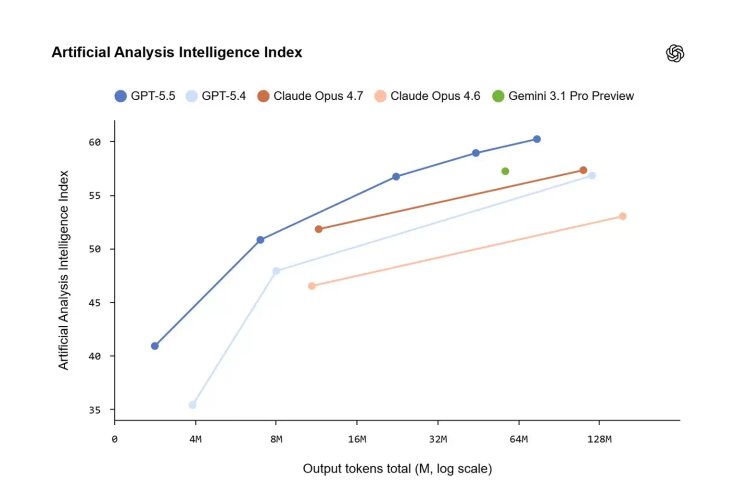
In several areas, GPT-5.5 is not only more capable but also more efficient, often achieving better results with fewer tokens and fewer iterations. In the Coding Index benchmark, the model delivers state-of-the-art coding performance at roughly half the cost of competing systems.
Improvements in coding
GPT-5.5’s strengths in programming are particularly evident in Codex, where it can handle engineering workflows end to end, from implementation to debugging, testing and validation.
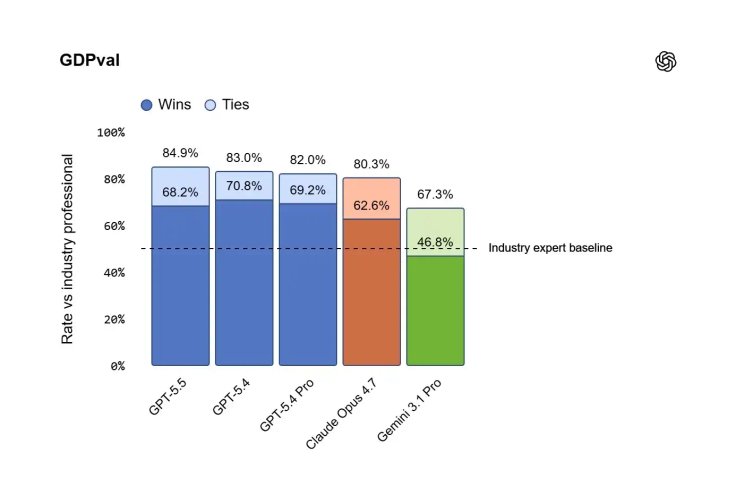
Early tests suggest the model performs better on real-world engineering tasks, including maintaining context across large codebases, diagnosing ambiguous errors, validating assumptions using tools and making targeted code changes.
Testers also report improved system-level understanding, including identifying why something fails, where fixes are required and what parts of the codebase may be affected.
Working with a computer
GPT-5.5 is also positioned as a more capable tool for everyday computer use. It better understands user intent and can more naturally complete the full knowledge workflow: searching for information, extracting key insights, using tools, verifying results and transforming source material into usable outputs.
In Codex, GPT-5.5 outperforms GPT-5.4 in generating documents, spreadsheets and presentations. The model moves closer to acting as a true computer assistant — able to interact with on-screen content, control a cursor, type, navigate interfaces and switch between tools as needed.









Editor’s pick