19:26
Government websites across Europe go offline over critical PHP flaws

17:37
Agile Robots unveils Nvidia-powered humanoid built to learn new skills

13:30
PHP warns website owners to prepare for emergency security updates

14:26
Australia prepares legal action against social media giants over under-16 ban

13:54
You can reserve Tesla’s new Roadster in the UAE for Dh210,000

18:26
Telegram launches Money, its built-in crypto wallet: Here's how it works
19:26
Government websites across Europe go offline over critical PHP flaws
17:37
Agile Robots unveils Nvidia-powered humanoid built to learn new skills
13:30
PHP warns website owners to prepare for emergency security updates
14:26
Australia prepares legal action against social media giants over under-16 ban
13:54
You can reserve Tesla’s new Roadster in the UAE for Dh210,000
18:26
Telegram launches Money, its built-in crypto wallet: Here's how it works
19:26
Government websites across Europe go offline over critical PHP flaws
17:37
Agile Robots unveils Nvidia-powered humanoid built to learn new skills
13:30
PHP warns website owners to prepare for emergency security updates
14:26
Australia prepares legal action against social media giants over under-16 ban
13:54
You can reserve Tesla’s new Roadster in the UAE for Dh210,000
18:26
Telegram launches Money, its built-in crypto wallet: Here's how it works
19:26
Government websites across Europe go offline over critical PHP flaws
17:37
Agile Robots unveils Nvidia-powered humanoid built to learn new skills
13:30
PHP warns website owners to prepare for emergency security updates
14:26
Australia prepares legal action against social media giants over under-16 ban
13:54
You can reserve Tesla’s new Roadster in the UAE for Dh210,000
18:26
Telegram launches Money, its built-in crypto wallet: Here's how it works


Russian authorities have begun gradually restricting Telegram’s operations in the country.
Over the past 24 hours, users across Russia reported significant disruptions, including slow media downloads, broken search results in channels, and general instability of the service.
Shortly afterward, it became clear that this was not a technical outage. According to RBC, citing sources familiar with the matter, the slowdown was intentional. Russia’s communications regulator, Roskomnadzor, later confirmed that restrictions were being introduced.
What is happening
Telegram has not been fully blocked. Instead, authorities are applying phased technical restrictions that degrade the platform’s performance.
This marks the latest stage in mounting pressure that has intensified throughout 2025:
- In August 2025, internet-based voice calls through Telegram stopped working in Russia.
- In October 2025, users began experiencing issues registering new accounts, as SMS verification codes failed to arrive.
- Now, authorities have moved to slowing down the platform itself.
Roskomnadzor stated that Telegram has “systematically ignored Russian legislation” and failed to address previously identified violations.
The regulator’s position
In its official statement, Roskomnadzor said Russia remains open to both domestic and foreign digital services, provided they comply with local laws.
The regulator’s core requirements include:
- Localized data storage within Russia
- Protection of personal data
- Anti-fraud measures
- Cooperation in combating extremism and terrorism
According to the regulator, Telegram has not met these conditions. As a result, “sequential restrictions” are being implemented, with the possibility of reversal should the violations be addressed. Officials have described the measures as gradual and reversible.
Fines and legal pressure
According to TASS, Telegram’s outstanding fines for violating Russian laws now exceed 29.6 million rubles (approximately $382,000). Earlier reports indicated that several new administrative cases had been opened against the company for refusing to remove prohibited content.
Authorities link the current restrictions to these unresolved legal issues.
Telegram’s response
Telegram founder Pavel Durov publicly addressed the situation, suggesting that Russian authorities are attempting to push users toward a “state-controlled app built for surveillance and political censorship.” He appeared to be referring to the Russian messaging app Max.
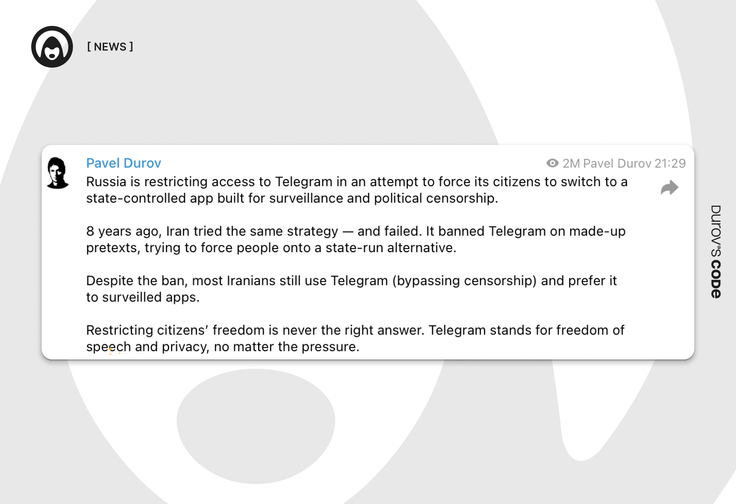
Durov also drew parallels to Iran’s attempt to ban Telegram eight years ago, noting that the platform continued to be widely used there despite restrictions.
He concluded:
“Restricting citizens’ freedom is never the right answer. Telegram stands for freedom of speech and privacy, no matter the pressure.”





Editor’s pick