18:26
Telegram launches Money, its built-in crypto wallet: Here's how it works

15:05
Telegram Desktop vulnerability allowed attackers to steal files with one click

12:33
Anthropic will ban repeated abuse of Claude under new usage rules

12:02
Apple could unveil its first touchscreen MacBook Pro on October 27

11:46
Meta bans TikTok ads on Facebook and Instagram in seven countries

11:25
Apple reportedly cuts iPhone 18 Pro orders just weeks after launch
18:26
Telegram launches Money, its built-in crypto wallet: Here's how it works
15:05
Telegram Desktop vulnerability allowed attackers to steal files with one click
12:33
Anthropic will ban repeated abuse of Claude under new usage rules
12:02
Apple could unveil its first touchscreen MacBook Pro on October 27
11:46
Meta bans TikTok ads on Facebook and Instagram in seven countries
11:25
Apple reportedly cuts iPhone 18 Pro orders just weeks after launch
18:26
Telegram launches Money, its built-in crypto wallet: Here's how it works
15:05
Telegram Desktop vulnerability allowed attackers to steal files with one click
12:33
Anthropic will ban repeated abuse of Claude under new usage rules
12:02
Apple could unveil its first touchscreen MacBook Pro on October 27
11:46
Meta bans TikTok ads on Facebook and Instagram in seven countries
11:25
Apple reportedly cuts iPhone 18 Pro orders just weeks after launch
18:26
Telegram launches Money, its built-in crypto wallet: Here's how it works
15:05
Telegram Desktop vulnerability allowed attackers to steal files with one click
12:33
Anthropic will ban repeated abuse of Claude under new usage rules
12:02
Apple could unveil its first touchscreen MacBook Pro on October 27
11:46
Meta bans TikTok ads on Facebook and Instagram in seven countries
11:25
Apple reportedly cuts iPhone 18 Pro orders just weeks after launch


Anthropic has unveiled two new fifth-generation AI models, Claude Fable 5 and Claude Mythos 5.
Both sit in a new tier the company calls Mythos, which Anthropic positions above its existing Opus lineup. Fable 5 is the publicly available version with stricter safety guardrails, open to all users and developers. Mythos 5 is being rolled out only to a small group of partners.
According to Anthropic, Fable 5 outperforms every model the company has previously released to the public. The gains are particularly visible in coding, scientific research, image-based tasks, and complex multi-step problems.
How the safety layer works
What sets Fable 5 apart is the way its safety layer is built. The model runs on the same Mythos-class foundation as its restricted sibling, but it sits behind additional guardrails that allow it to be released to a wider audience.
Mythos 5 is essentially the same model with some of those restrictions lifted in specific domains. It is being deployed through Project Glasswing, a joint initiative with the US government, with access initially limited to cybersecurity specialists and operators of critical infrastructure. Anthropic claims Mythos 5 is the strongest cybersecurity model in the world.
Fable 5 also includes a built-in fallback mechanism. When a secondary safety model judges a request to be potentially unsafe, the system disables Fable 5 and routes the response through Claude Opus 4.8 instead. Anthropic acknowledges that the trigger can fire on relatively benign queries as well. Alongside this, all traffic to Mythos-class models is subject to a 30-day retention policy. The company says the data is not used for training and is deleted in most cases.
Performance
According to benchmarks Anthropic published with the launch, Fable 5 leads in almost every test the company shared. On SWE-Bench Pro, a widely watched coding benchmark, the model scored 80.3%, against 69.2% for Opus 4.8 and 58.6% for OpenAI's GPT-5.5. On one of the analytical reasoning tests, it became the first model to cross the 90% mark.
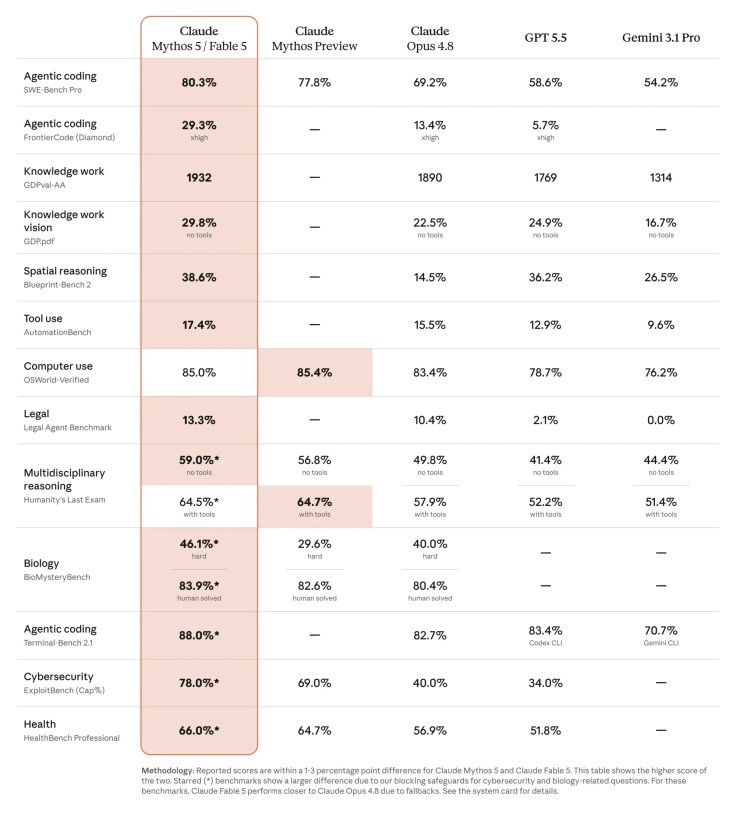
All of these results come from Anthropic itself, and no independent public testing has been released at the time of the announcement.
The company also offered a real-world example. According to Anthropic, Stripe used Fable 5 in early testing across a 50-million-line codebase, and the model compressed work that would have taken more than two months into a single day.
Pricing and availability
Until June 22, 2026, Fable 5 is included at no extra cost in the Pro, Max, and Team plans. The company has noted, however, that the model burns through usage limits twice as fast as Opus 4.8.
After June 23, Fable 5 will be removed from subscription plans and made available only through paid credits on claude.ai and through the API. Anthropic has said it may eventually return the model to subscription access once it has scaled up enough compute capacity, but no timeline has been shared.
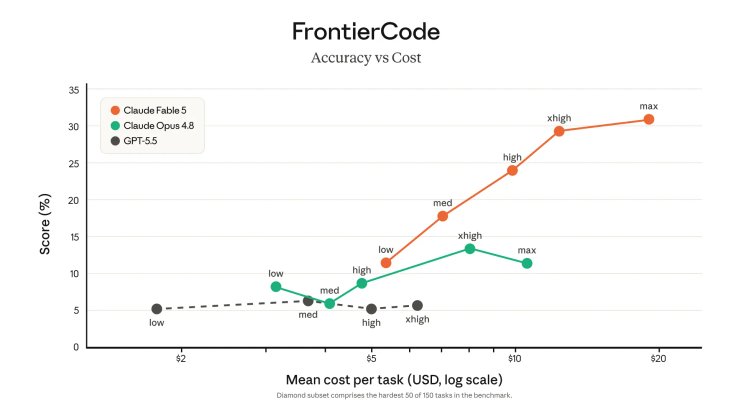
Fable 5 is available through the Claude API under the identifier claude-fable-5, as well as in Claude Code, on enterprise plans, and on AWS, Google Cloud, and Microsoft Foundry. Pricing is set at $10 per million input tokens and $50 per million output tokens, twice the cost of Opus 4.8. According to the company, that is still less than half the price of the preview version of Mythos.








Editor’s pick