10:50
ChatGPT, Claude and Gemini give wrong answers to 57% of personal finance queries, study finds

10:22
US proposes AI incident alert system with China

13:12
Australia could ban camera-equipped smart glasses

11:51
Researchers used Anthropic’s Claude to breach OpenAI employee accounts

17:09
iPhone 18 Pro vs iPhone 17 Pro: should you upgrade?

15:00
OpenAI details six cases of AI models hiding errors and taking unauthorized actions
10:50
ChatGPT, Claude and Gemini give wrong answers to 57% of personal finance queries, study finds
10:22
US proposes AI incident alert system with China
13:12
Australia could ban camera-equipped smart glasses
11:51
Researchers used Anthropic’s Claude to breach OpenAI employee accounts
17:09
iPhone 18 Pro vs iPhone 17 Pro: should you upgrade?
15:00
OpenAI details six cases of AI models hiding errors and taking unauthorized actions
10:50
ChatGPT, Claude and Gemini give wrong answers to 57% of personal finance queries, study finds
10:22
US proposes AI incident alert system with China
13:12
Australia could ban camera-equipped smart glasses
11:51
Researchers used Anthropic’s Claude to breach OpenAI employee accounts
17:09
iPhone 18 Pro vs iPhone 17 Pro: should you upgrade?
15:00
OpenAI details six cases of AI models hiding errors and taking unauthorized actions
10:50
ChatGPT, Claude and Gemini give wrong answers to 57% of personal finance queries, study finds
10:22
US proposes AI incident alert system with China
13:12
Australia could ban camera-equipped smart glasses
11:51
Researchers used Anthropic’s Claude to breach OpenAI employee accounts
17:09
iPhone 18 Pro vs iPhone 17 Pro: should you upgrade?
15:00
OpenAI details six cases of AI models hiding errors and taking unauthorized actions


ChatGPT, Claude and Gemini give wrong answers to 57% of personal finance queries, study finds
Popular AI models gave incorrect answers to personal finance questions 57% of the time on average, according to a study by fintech company Saturn.
The researchers tested 18 models, including ChatGPT, Claude, Gemini, Copilot and Grok, on 121 questions covering pensions, taxes, debt and savings. Each question was asked five times to test the consistency of the responses, producing more than 10,000 answers in total.
On more complex tasks requiring multiple calculations, the average error rate rose to 88%. Some models answered 99% of such questions incorrectly, the Financial Times reports.
The researchers did not classify responses as incorrect only when they contained faulty calculations or factual errors. Answers also failed if they omitted material details or important warnings. According to Saturn, chatbots made calculation errors, overlooked upcoming changes to tax law and, in some cases, invented rules that did not exist.
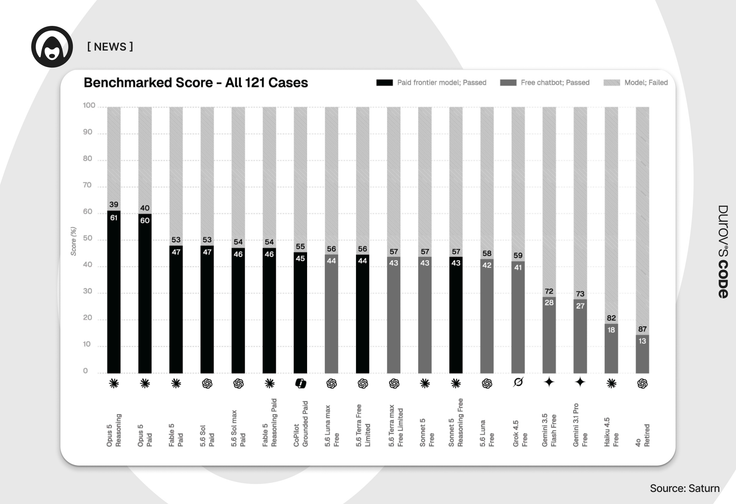
- Claude Haiku 4.5 had the highest error rate among the results included in the report, with errors found in 82% of its responses;
- Gemini 3.1 Pro was wrong 73% of the time;
- Grok 4.5 had an error rate of 59%;
- GPT-5.6 Luna had an error rate of 58%.
Claude Opus 5 in reasoning mode was the most accurate model tested, though 39% of its responses were still classified as incorrect.
Free models performed worse on average than paid ones, with error rates of 63% and 49%, respectively. On the most difficult questions, free models gave incorrect answers 93% of the time.
In one example, Claude Haiku 4.5 incorrectly explained how pensions are taxed in the UK. Saturn estimated that following the model’s advice could have resulted in an additional £17,500 tax bill. In another case, Claude invented a rule suggesting that a graduate could stop repaying a student loan after moving abroad.
The researchers also found problems with advice given to people in debt. Some models recommended paying off the debt with the highest interest rate first without accounting for priority payments such as rent and council tax.
Saturn itself develops AI tools for financial advisers and advocates for regulation of financial advice provided by general-purpose chatbots. The findings therefore reflect the company’s own methodology and evaluation criteria.









Editor’s pick