17:14
Capcom breach exposes 11.7 million account records worldwide

16:56
Anthropic introduces Claude Duet, an AI assistant that checks in first

16:32
Hugging Face’s new AI lets scientists chat with DNA

19:26
Government websites across Europe go offline over critical PHP flaws

17:37
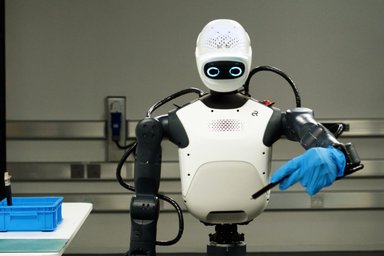
Agile Robots unveils Nvidia-powered humanoid built to learn new skills

13:30
PHP warns website owners to prepare for emergency security updates
17:14
Capcom breach exposes 11.7 million account records worldwide
16:56
Anthropic introduces Claude Duet, an AI assistant that checks in first
16:32
Hugging Face’s new AI lets scientists chat with DNA
19:26
Government websites across Europe go offline over critical PHP flaws
17:37
Agile Robots unveils Nvidia-powered humanoid built to learn new skills
13:30
PHP warns website owners to prepare for emergency security updates
17:14
Capcom breach exposes 11.7 million account records worldwide
16:56
Anthropic introduces Claude Duet, an AI assistant that checks in first
16:32
Hugging Face’s new AI lets scientists chat with DNA
19:26
Government websites across Europe go offline over critical PHP flaws
17:37
Agile Robots unveils Nvidia-powered humanoid built to learn new skills
13:30
PHP warns website owners to prepare for emergency security updates
17:14
Capcom breach exposes 11.7 million account records worldwide
16:56
Anthropic introduces Claude Duet, an AI assistant that checks in first
16:32
Hugging Face’s new AI lets scientists chat with DNA
19:26
Government websites across Europe go offline over critical PHP flaws
17:37
Agile Robots unveils Nvidia-powered humanoid built to learn new skills
13:30
PHP warns website owners to prepare for emergency security updates


Anthropic has unveiled Claude Opus 5, its new flagship AI model that comes close to matching the intelligence of the top-tier Claude Fable 5 while costing half as much, the company announced in a blog post.
According to Anthropic, Opus 5 sets new company records on coding and knowledge benchmarks, including Frontier-Bench and GDPval-AA, although it still trails Mythos 5 in cybersecurity-related tasks.
- On Frontier-Bench v0.1, Opus 5 scored more than twice as high as Opus 4.8 while completing tasks at a lower cost. On CursorBench at the highest reasoning level, it came within 0.5% of Claude Fable 5's peak score while costing half as much.
- On ARC-AGI 3, which measures performance on novel reasoning tasks, Opus 5 achieved a score three times higher than its closest competitor. On Zapier AutomationBench, the model completed business automation tasks roughly 1.5 times more often than competing models at the same cost. On OSWorld 2.0, which evaluates computer-use capabilities, Opus 5 outperformed every competing model across all pricing tiers, surpassing Fable 5's best score at roughly one-third of the cost.
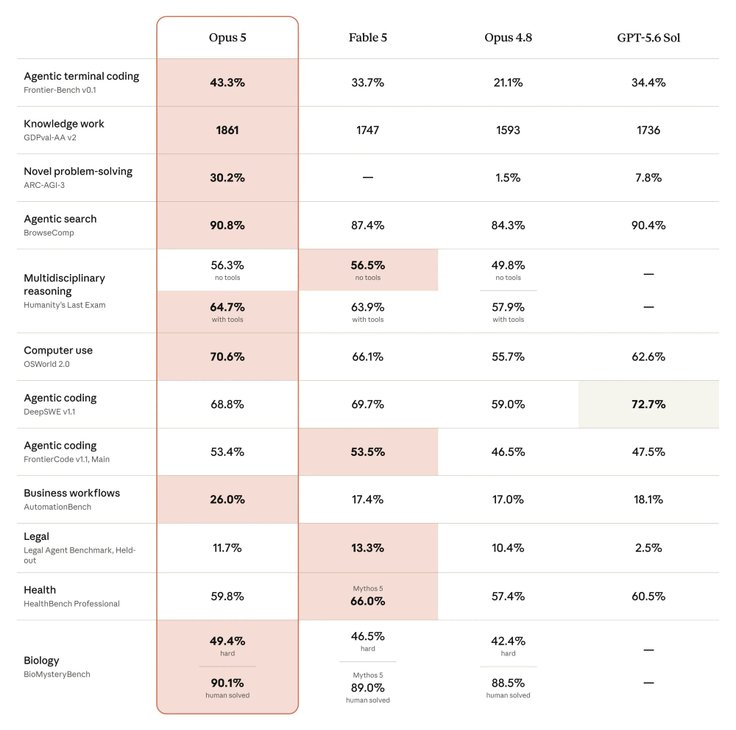
Anthropic also highlighted major improvements in scientific reasoning. Compared with Opus 4.8, the new model scored higher across every natural science benchmark, including structural biology and organic chemistry.
The company added that automated evaluations identified Opus 5 as its most aligned model to date. It hallucinates less frequently, is more resistant to attempts to induce harmful behavior, and is less likely to take risky irreversible actions.
Anthropic also addressed the model's cybersecurity capabilities. While Opus 5 has become stronger at cybersecurity tasks thanks to its overall intelligence gains, the company says it was not specifically trained for offensive cyber operations. As a result, it still significantly trails Mythos 5 at turning discovered vulnerabilities into working exploits, even though its vulnerability discovery performance is now approaching that level.
Pricing remains unchanged from the previous generation at $5 per million input tokens and $25 per million output tokens. Opus 5 is also available in a Fast mode, which is approximately 2.5× faster than the standard version and costs twice as much.









Editor’s pick