What’s new in Nano Banana 2.1 and how much it costs
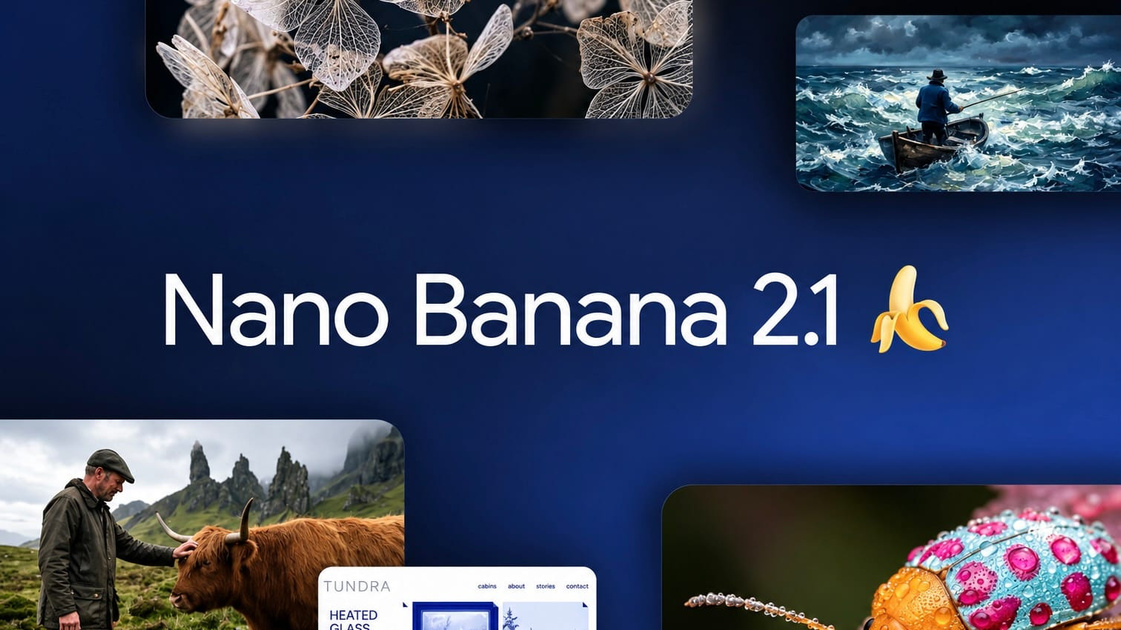
Google has released Nano Banana 2.1, promising more reliable image editing, clearer text and more natural-looking pictures, with lower API prices for generated images.
The update succeeds Nano Banana 2, also known as Gemini 3.1 Flash Image. Google says the new version follows prompts more closely, improves text readability and handles complex infographic layouts more accurately. It supports 1K, 2K and 4K output, with 1K as the default.
Editing is another focus. Google reports improvements to changing selected areas using masks or drawn instructions, and to preserving the appearance of people and objects across successive edits. These capabilities are useful when creating several versions of a product image or keeping the same characters recognizable throughout an illustrated story.
The model can combine up to 14 reference images, with support for maintaining the appearance of up to four characters and the details of up to ten objects. The same reference limits applied to Nano Banana 2, so the improvement concerns consistency when combining and editing images. Google’s published tests show gains over its predecessor in general editing, character consistency and infographic design.
Panoramic images also receive a specific fix. Google says it has addressed visible tiling artifacts at 2K and 4K in unusually wide or tall formats, including 8:1 and 1:8. Those aspect ratios, along with 4K generation, were already supported by Nano Banana 2.
Nano Banana 2.1 can use Google web and image search results to inform its output, continuing a capability available in the previous version. Developers can also choose minimal, medium or high Thinking levels, with medium as the default. Through the Gemini API, the model accepts text, images, video and PDF files, with limits of 131,072 input tokens and 32,768 output tokens.
Google’s own evaluations indicate better results, although the company still identifies small text and character consistency as areas for improvement. Small lettering can remain blurry, particularly at 1K, and edits may not always follow every instruction.
For developers, image output prices have fallen across all three resolutions. Google’s standard API rates show how the two versions compare.
| Output resolution | Nano Banana 2 | Nano Banana 2.1 |
|---|---|---|
| 1K | $0.067 | $0.0336 |
| 2K | $0.101 | $0.0504 |
| 4K | $0.151 | $0.113 |
That makes 1K and 2K image output approximately 50% cheaper, with a reduction of about 25% at 4K. Input processing is billed separately and has risen from $0.50 to $1.50 per million tokens. Text and reasoning output now costs $7.50 per million tokens, up from $3, so the total saving depends on the request.
Nano Banana 2.1 is available through Google AI Studio and the Gemini API. Google also lists the Gemini app, Search’s AI Mode, Flow, Stitch and Google Ads among the services distributing the model.